Hope Dances with the Butterflies

LAURA DE VIVO

Third-year NTU BA Creative Writing student Laura De Vivo discusses collaborating on a performance at Nottingham Royal Concert Hall – with brief cameos for several other NTU Creative Writing students, past and present!
It was a rainy Wednesday morning and I was making my way through the city to meet Paul Adey, a lecturer at Confetti and graduate of NTU’s BA, MA and PhD programmes, and various other creative types, in the belly of Metronome. I knew little about Paul and his work (he is the hip hop artist Cappo), though I’d gleaned a few things from the emails we’d exchanged when I had thrown myself at the opportunity of collaborating on reimagining a Greek Myth.

My confident stride slowed as I began to realise I didn’t know anyone else who was taking part. I arrived early, a little bedraggled, to find John and Kai, two NTU MA Creative Writing students and writers I knew from WRAP, and felt a little less uneasy.

Paul welcomed us with a cheery smile and took us to meet the four musicians and three other writers who would collaborate on the project. As Paul began to explain the requirements, I came to realise I really hadn’t read the small print – I’d just seen a writing opportunity and thrown myself at it. What was this talk of producing something in an afternoon and reading on the stage of the Royal Concert Hall?I made a mental note to read things more closely in future.

After the introductions we set to the task of brainstorming, discussing various myths we knew and how we could play with the images with both words and sound. Eventually, we settled on my suggestion of Pandora’s box. The notion that the world is in chaos, but we still have some control over an outcome, however negative the situation, seemed fitting.

Then I had to put pen to paper. Idea after idea was scribbled down, dissected, discarded, regurgitated, until I had something that would need serious editing, but at least it was something. I was rather unconfident about my efforts when we broke for lunch. Over the next hour my brain roared into overdrive: make it work, make it work, make it work repeated over and again in my head. I have never been able to produce something on the spot, I have learned I’m just not that kind of writer, but I wasn’t about to let the project, Paul, or Oba, the musician I was working with, down – so I just had to make it happen. I couldn’t wait for the stars to align. This was a lesson in collaboration outside of university. It was a lesson in the pressures that are out there for a writer.

With lunch done, it was back to the sound room. I still wasn’t happy with what I’d produced but it was time to show it to the group anyway. Despite the positive response, I went home to think, away from the pressure. And over the course of the two weeks between meetings I worked on it with Oba. By the one and only dress rehearsal we had something that had a little of both of us in it and we were happier. Ah, but Paul felt it wasn’t long enough!

I’d been given the task of writing ‘hope’, and was last to rehearse, giving me precious additional moments to write. I used the same words as the first stanza but with changes to create slightly altered images. Writing distracted me from the sheer size of the Royal Concert Hall, though periodically I also had to stop myself from counting rows in order to control the anxiety. How could I stand on that stage? Who wanted to listen to little old me?

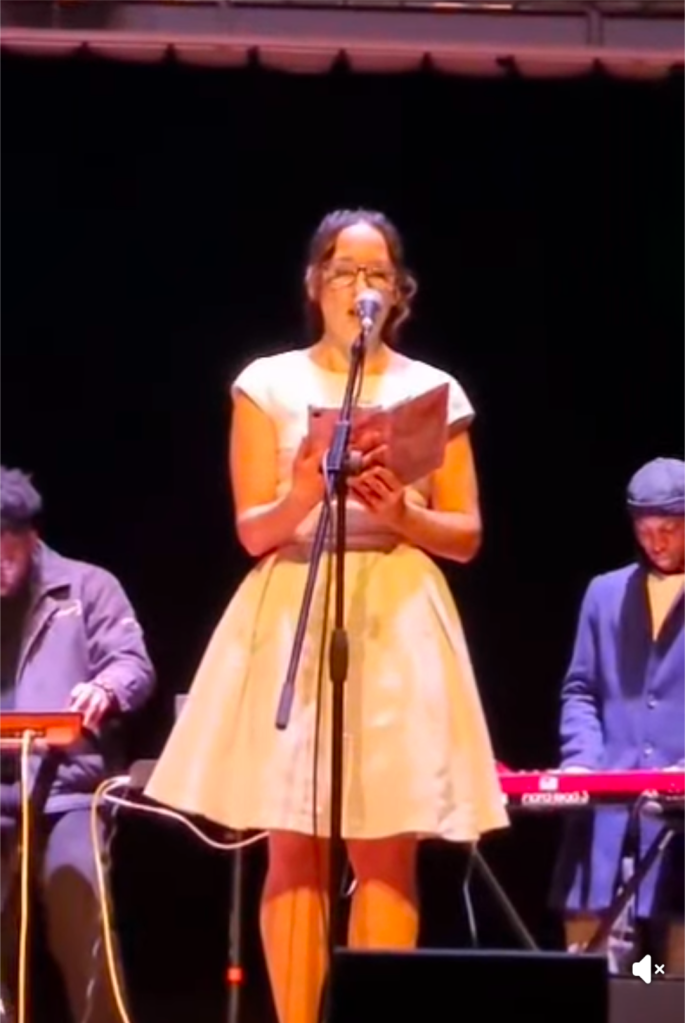
Empty of props or equipment, the stage looked intimidating. I stared out at the empty auditorium, my heart pounding, as I read my poem calmly and slowly. I was relieved to get the last word out, and stood demurely as I was faded out.

Another two-week gap followed before the real deal. I tore my wardrobe apart looking for something that intimated hope, and opted with the floatiest dress I could find – a light apple-green one that, from a distance, looked white. It would do the job, I’m creative, after all.

I arrived at the theatre in time to watch the collaboration before ours. Then, at the halfway point, I slid out of my chair and ran around the theatre in the rain to the stage door. There we waited. The applause of the audience was our cue, and our part of the show began. I watched from the wings, my butterflies dancing harder as each writer read and left.  Being last meant I had to suffer the whole anxious agony of the wait.

 But when Oba began our music, I was no longer Laura the nervous writer, I was Laura the confident orator. Three and half minutes later, the collaboration was over, and the butterflies stopped dancing.

Has the experience deterred me from collaborating? Absolutely not, but in future I will certainly make sure I know what is required before jumping in! Despite my nerves, I have come to understand that I thrive in a collaborative project. Solo projects leave me with no one to make those final decisions with or bounce ideas off, whereas collaboration makes me part of a team, all pulling in the same direction to achieve the best possible outcome, something I couldn’t have done on my own. That is the real value in collaborative art.

INSPIRED BY PAIN

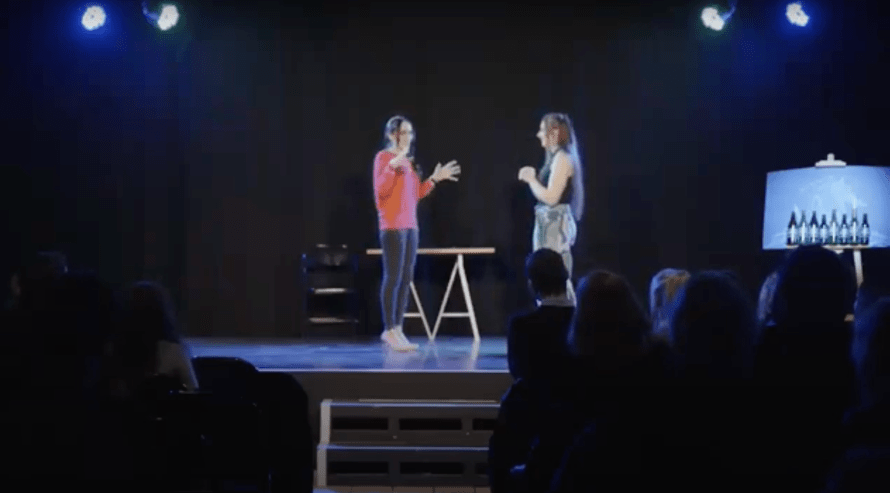
Second-year BA Creative Writing student Laura De Vivo recently watched her monologue, ‘The Demon in My Head’, being performed on stage. In this blog post, she writes about what inspired her, and the experience of seeing the work brought to production. You can watch it below.

When inspiration hits, its like a bolt of electricity through the body. Writing can be cathartic, and that was certainly the case here. I suffer from the rare condition called trigeminal neuralgia. The need to be strong, to fight it, to be the one that stays on top is a daily battle and not one I always win. Not only that, but I go head-to-head with an invisible demon. How can I fight it? With what I have at my disposal: words.

The opportunity to fight came, surprisingly, in the form of a writing prompt from a wonderful theatre company directed by Alice Connolly. Set up during lockdown, Message in a Bottle Monologues provides opportunities for writers and actors to collaborate. Initially, this was over Zoom, but word spread fast as the world has opened back up.

Alice, herself a writer and actress, provides the prompt; the writers provide the material; the actors provide the performance. In November 2023, the prompt was ‘Darkness and Light’, and instantly I knew what I would write. I was going to give trigeminal neuralgia a form and put it in its place while raising a little awareness.

Writing about something so personal and so raw was easy. As Hemingway said, ‘just sit at your typewriter and bleed’. I played on the qualities of each symptom and my reactions to them; I took all my anger from deep in my belly and exploded it onto a page. With the piece written, I nervously sent it off to Alice, not knowing whether it was what she was looking for. She loved it, and my five minutes of anger was accepted.

The premise of the show is clever: the writers and actors all remain anonymous; the actor is revealed at the beginning of each performance, and the writer at the end. On the night, you are invited to attend as an audience member. While mingling with drinks, there is an expectation that you will not discuss anything that might undermine the mystery. The theatre is littered with writers, actors and spectators, only Alice knowing who is who, and how they have been paired.

I sat through each performance on the edge of my seat, afraid to breathe, not knowing when my piece would be announced, trying to concentrate on the other pieces, and – more than anything – worrying about myself being revealed. I even had a painful wait through the interval. Finally, second to last, the title of my piece was announced. This was it – my talent, or lack of it, was about to be laid bare. I held my breath, eyes unblinking, as James Doolan (‘my’ actor) took to the stage. I was transfixed. Would he play it how I hoped? Would he give it the anger I had when writing it? Would it live up to my expectations?

I was in awe. Every raw emotion was delivered with all the venom I had intended. Yet I couldn’t believe those words were mine, that they had taken a journey from my head through my fingers then out of his mouth, almost seamlessly.

As a writer I hide behind my laptop, never needing or wanting to be seen, yet my moment in the spotlight was coming. All the writers were interviewed, to shed some light on their pieces. Standing on that stage was daunting, but after James’s wonderful performance I was proud to claim every word. When the show was over, I was suddenly swamped with people congratulating me on a job well done, asking to stay in touch, asking what was next. It was overwhelming, an insight into things that could be mine with hard work and determination, and I left the theatre that evening feeling like I had won an Olivier Award. It was an inspiring experience that had me burning for more. And I had put trigeminal neuralgia in its place. For a little while, anyway.

CREATIVE WRITING: NOT JUST A DEGREE

Second-year NTU BA Creative Writing student Claire Hickenbotham tells us about her experiences on the course.

The look I got when I told people I was going to university! It was a look of awe, in most cases, actually: people were impressed that I, a 39-year-old parent, was resuming education twenty years after I had left it. Body language gave away what false smiles hid. I was making all this effort to study in higher education, to give up my job, my routines, my financial stability.

Reality hit when I found myself in a classroom with people twenty years my junior. Even the lecturer appeared younger than me! I retrieved my trusty pen and paper only to find most other people now use laptops, tablets, even phones. I wondered if I could cope in this new world of online learning rooms, Teams meetings, e-books. It was all so new to me. I had two choices: to embrace it and pursue my love of writing; or to run for the hills, drop out of uni for the second time, and forgo any chance to start again – student finance wouldn’t cover a third attempt.

But, as I settled into my new life as a student, doors started opening, doors that had previously been locked, or hidden. I realised how trapped I’d been, stuck in an admin job where I spent more time watching the slow ticking clock than enjoying the mind-numbing tasks issued by my boss. All the while I had a completed novel, short stories and blog entries clogging up my PC – all unread by the public, all wasting away on a hard drive. I didn’t know what to do with them. How does an unpublished writer become published? Where do you go? Who do you speak to?

The answers became clear at uni. Not only have the workshops and seminars helped me dramatically to improve my writing, but I have been made aware of competitions, magazines submissions, volunteering opportunities, writing groups. I joined WRAP, an NTU reading and writing group, where I met fellow students with a love of literature. They gave me the courage to enter my first competition. I cried when I found out I was a winner. My piece was published, and I had the privilege of reading it on stage. I walked out trembling, terrified I’d mess it up: I was way out of my comfort zone. But the applause made it all worthwhile. My work was finally out in the world.

Since starting my degree, I’ve made lifelong friends, my confidence has soared, and my writing is better than it’s ever been. I’ve been published twice, I work as a mature student ambassador, and I volunteer at WRAP. Being part-time allows me the opportunity to get involved in activities I may not have had time for otherwise. I live twenty miles away and juggle my commute with the school run, my studies with parenting. It’s not always easy. Finding time to write can be a challenge. But I am determined to get the most out of my time at university.

Creative Writing isn’t just a degree, it’s a a leap forward, and the achievement of a lifelong dream.