JULIE GARDNER, a PhD candidate in Creative Writing at NTU and the author of the pamphlet Remembering (Five Leaves Publications), reviews a book she wishes she’d had when she took the MA Creative Writing.
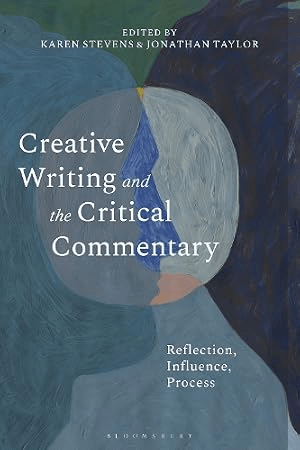
Anyone studying creative writing at undergraduate or post-graduate level will almost certainly be required to write a critical commentary to accompany each piece of creative work they submit. The first time I was asked to provide one, whilst studying for the MA in Creative Writing at NTU, I wrote a lot about the work of writers who had influenced me but hardly anything about how they had been brought to bear on my own output, so I was (quite rightly) criticised. Resources had been provided, but there were no published anthologies of critical commentaries at the time. If Creative Writing and the Critical Commentary had existed, and I had read it, I think I would have done better. Editors Karen Stevens and Jonathan Taylor have produced a book that, in their words, ‘aims to address that strange pedagogical gap’ and it will, I am sure, soon be on the reading lists for most Creative Writing courses in the UK and beyond.
Stevens and Taylor suggest that the world of creative writing is a mirror-world: ‘You learn to write – or learn to write better – by reflecting on your own work and the work of others. The mirror-world reflects both yourself and your (literary) surroundings, and you learn by studying those reflections, by staring into the mirror.’ I like this image of a writer staring obsessively into a mirror, rather like Snow White’s stepmother. I’m not suggesting writers are evil or vain, but we can be insecure and we need to be willing to look at ourselves (or at least our work) carefully, paying close attention to small details.
Part one, which comprises three chapters jointly written by the editors, is a usefully thought-provoking introduction to the rest of the book. For those in the early stages of a writing career, particularly those following a formal course at university or college, there are useful lists of what might be included in a critical commentary, with questions to consider.
Part Two provides the twelve sample critical commentaries and it is this section that gives legitimacy to the editors claim that ‘there seem to be no other books like this one’. The contributing writers ‘have experience as both published authors and educators in higher education,’ and ‘encompass, in both spheres, all the major forms of writing (prose fiction, creative non-fiction, script writing, poetry and new media)’. Each chapter ends with ‘works cited,’ an extensive and eclectic list for further reading.
I wondered if it would be frustrating to read commentaries without first having access to the creative work, and at times it was. Ideally, I would have liked to have read Steven’s short story ‘Among the Crows’ before I read her discussion around it, but (like all the contributors) she at least provides quotes from the story and information about its content. As I worked my way through subsequent chapters – Stevens’ commentary was the first – I decided that these essays worked perfectly well as discrete pieces. I found that I was applying what I was reading to, and finding inspiration for, my own practice. As a poet, I was especially interested in Shaindel Beers’ essay, ‘Nature and Chance as Poetic Influence’, and Lily Matsumoto’s, ‘Experimental Poetic Autography: Writing the Languaged Self’, but every chapter offered useful insights. I particularly enjoyed David Swann’s ‘commentary -in-flash’ about his novella-in-flash, Season of Bright Sorrow. Kit de Waal also writes about flash fiction, comparing it to parables from the bible: ‘both forms invite readers to engage deeply with the subtext, relying on suggestion and resonance rather than explicit explanation.’ Dan Powell’s contribution, ‘The End Is Never Where You Think’, introduced me to preclosure theory, and included the final two paragraphs of his short story ‘Not the Fall’. I am now eager to read it in its entirety and interested to see how that reading is affected by my prior reading of the commentary.
Anyone who believes that there is a formula for writing a critical commentary will, on reading this book, find that they are mistaken. The twelve essays are all very different in style and tone. What they do have in common is the writers’ willingness to share openly about their own work, and there is generosity in this. These are, in effect, masterclasses. Without doubt the book will be extremely useful to those tasked with writing critical commentaries, but it has much to offer all writers, and indeed many readers.
Stevens and Taylor make a bold claim for critical commentary: ‘If approached with the same thoughtfulness as the creative work, they are not only profoundly helpful to an author, they might also stand as works of art in themselves.’ This book provides evidence to support that claim.