Creativity and the Journalistic Mindset

MEGAN TURNER, a student on the MA Creative Writing, reflects on her journey towards taking the course after an undergraduate degree at NTU and beginning a career in journalism.

I made a bold move just before I started this MA: I left my day job in the media. My writing had become stripped, stale and quite sad, and I wanted to do something about it.

Accuracy came first, and brevity was very important. All the while, my internal voice could never get louder than a whisper. Journalism trained me to strip myself from the page – to record, report, and then disappear again. It’s a valuable skill, but I wanted to find room again for myself in my writing.

Since stepping out of that industry, I have rediscovered something magical: self-expression that I don’t feel ashamed of sharing. Creative writing doesn’t ask for neutrality. I can ask my gut what it thinks. However, after relying on quotes and sources, day in and day out, the idea of writing exactly what I think felt daunting.

When watching, reading or listening to the news, there is usually one clean version of events, shaped to be understood quickly. In the real world, and in creative writing, there are as many versions as there are characters – and then usually a lot going on beneath the surface too. Points of view shift. Memories are messy. People lie – to each other and to themselves.

However, I have been finding it useful to use some of the quirks of my recent job as material, especially when remembering you’re allowed to imagine beyond what is provable.

The following things are helping me to write creatively – and perhaps they will be of some value to you:

  • Scheduling what I think of as “no-pressure writing windows”, where I am free to write something that might be so awful I never look at it again – because it also might not be. Incomplete is better than non-existent. Consistency, practicing the craft regularly, helps my ideas flow.
  • Asking “What if?” to drive my work and go on a journey with it. Imagination will take over where evidence stops.
  • Switching off my ‘inner editor’, especially during early drafts. Spelling and accuracy checks are important, but stopping my creative flow to get them done does not help.
  • Listening to real people’s speech patterns – how they interrupt, use slang, pause, and so on. I’ve been writing dialogue out loud to hear if it feels like a real person speaking naturally, not just like a soundbite.
  • Writing in multiple forms is tricky, but helpful for finding your voice. I’ve been focusing on very short stories and poetry, but I know pushing myself in different forms, like scripts and prose poetry, is also helping me find styles I suit.
  • Trusting other people’s imaginations. It’s okay to leave gaps, give half-truths and hazy recollections of stories. Creative writing isn’t a journalistic report. I’ve been trying to write with restraint to help readers contribute to how they create meaning.

I do think my journalistic mindset and training is valuable when writing ‘creative’ work. It makes me look closely at people, places and the chaos within daily life, the kinds of things that go unreported. I do miss the rush of working in a newsroom, but I am finding writing for myself, not out of duty, very enjoyable. The feeling of slowly becoming more myself and present on the page for the first time in a long time is electric. A voice I spent years hiding is finally getting louder.

WRITING IN SOLIDARITY

MA Creative Writing student R.J. Eaton gives a personal perspective on writing to express solidarity with causes that matter to her, and introduces a new short poem of her own.

Words have power. This is something I am very aware of, increasingly so.

I write both fiction and poetry, and it is in my poetry that I most obviously express personal thoughts and feelings, especially on subjects seen as political or in some cases controversial. I find it easier to express myself about complex and often upsetting subjects in poetry, carefully considering what I say and how I say it. I often to write on subjects in which I have a personal stake, and have written poems that engage with feminism and LGBTQ+ rights, because as a queer woman I want issues that affect me heard.

However, I also write on subjects that don’t affect me personally or directly – in part, to express my solidarity. Poems, songs, novels all get quoted at protests, in speeches, in articles, and writers can use their talents, and in many cases their platforms, to spread awareness about the things that matter to them.

Often, I feel, people are ignored because of things like race, gender, and sexuality. Although this is changing, in many places, I feel it is still important for writers to use their voices to advocate for the things they’d like to see change, even if those things primarily involve others – male writers can use their voices to advocate for women’s rights, straight writers can support queer people, and white people can write in solidarity with people of colour. While we should, first and foremost, centre people who are directly impacted in discussions about their specific rights, I believe support and solidarity from others still helps.

It is in that light that, as a white British writer, that I urge other writers, wherever they are from, to turn their skills to writing about specific social and political events and concerns, even if those things are not directly impacting them. For me, this includes the situation in Gaza, which in December last year Amnesty International described as including ‘acts prohibited under the Genocide Convention’. People’s rights to freedom and peace have always been important to me. In writing poetry about these things, one example of which is the poem below, I hope to help spread awareness, to encourage empathy, and to express solidarity with those directly impacted.

Using writing to express solidarity is, potentially, a slippery slope – something that requires considerable care. However, it can be a powerful tool. I can only speak from personal experience, but as a queer woman, seeing poetry or other writing that expresses support for people like me gives me hope, and lets me know that people support everyone being equal and an end to injustices against us.

I strongly encourage writers who have not done so to think about writing in solidarity with a cause dear to them – they might inspire others, and might even provide glimmers of hope. And doing so may well help you understand, and express, your own potentially complicated feelings on complex or even maligned topics.

I hear children scream

outside the house.
Adults sigh, huff, complain:
“Why can’t they be quiet?”

In Gaza, children also scream.
No adults complain about it,
because the quiet is worse.

WHAT HAVE YOU BEEN READING?

We asked some of our postgraduate researchers in Creative Writing to tell us about a few things they have read and particularly enjoyed in 2024.

RAMISHA RAFIQUE

During the summer, I found an amazing article about Nida Manzoor’s We Are Lady Parts – a TV show about a female Muslim Punk Band. Muzna Rahman’s ‘Indigestible performances: Women, punk, and the limits of British multiculturalism in Nida Mazoor’s We Are Lady Parts’, in The Journal of Postcolonial Writing (2024), was really entertaining to read. I wished she’d written it sooner, as it made me want to write about a Punk Postcolonial Flâneuse (something I’m currently working on). I also made a conscious decision to read more poetry and fiction by Palestinian writers and poets. Two poetry collections that stood out to me were Forest of Noise: Poems by Mosab Abu Toha (2024) and Hasib Hourani’s Rock Flight (2024), both beautiful expressions of resistance and empowering Palestinian voices. Hourani also visited Nottingham for a reading at Five Leaves Bookshop in December, and I thoroughly enjoyed listening to him read. Links: https://www.tandfonline.com/doi/full/10.1080/17449855.2024.2361148 https://fiveleavesbookshop.co.uk/product/rock-flight/ https://fiveleavesbookshop.co.uk/product/forest-of-noise/

JULIE GARDNER

My supervisor once told me that I can’t just write about the poets I like, but here I am writing about two of them. Barbara Kingsolver is well-known as a novelist but I hadn’t realised until recently that she is also a poet. The poems in How To Fly (in Ten Thousand Easy Lessons) are accessible, witty and thought provoking. The first poem in the book is ‘How to Drink Water When There is Wine’. It begins, ‘How to stay at this desk when the sun / is barefooting cartwheels over the grass.’ I was hooked. Rebecca Goss is one of those poets whose name is familiar but who never seems to be in the limelight. I think she should be. Her fourth collection, Latch, was perhaps my favourite poetry find of the year and having read it I wanted to read more. Since then, I have also read two of her earlier collections, Her Birth and Girl. They didn’t disappoint.

LUCY GRACE

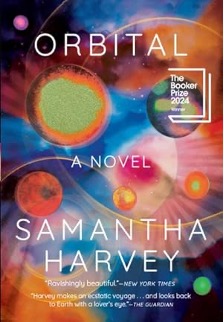
Two short novels I’ve enjoyed recently are Clear by Carys Davies (Granta, 2024) and Orbital by Samantha Harvey (Vintage, 2024). At 146 and 136 pages respectively, they could be seen as quick reads, but it is worth lingering over the carefully crafted sentences. Clear is set in 1843 on a small island between Shetland and Norway, and Orbital is set on an orbiting space station. Both have limited characters with different languages and ways of being, both describe the natural world, and both have a ‘ticking clock’ device – over a period of four weeks and over a single day. The concise writing is an excellent model for my own fiction. Orbital is available to listen to here. In my thesis, I’m writing about literature concerned with geology, deep-time and Iceland. Here, artist Ilana Halperin discusses ‘the idea of living in geologic solidarity. We are part of a growing geosocial family with shared responsibility that extends across the surface of the Earth.’ I first came across her work in Nottingham Contemporary Gallery in this 2022 exhibition.

STEVE KATON

Two of the favourite things I read last year were Storyland: A New Mythology of Britain and Wild: Tales from Early Medieval, both written by the historian Amy Jeffs. Storyland starts with an origin story for Albion, describing how it was populated by Syrian refugees, all women, who were washed up in a small boat on the Kent coast. (Anyone sensing the irony there?) They gave birth to giants after coupling with fallen angels! Each chapter in both books begins with one of Jeffs’ excellent retellings of an old myth, followed by a critical analysis talking about her sources, her travels and any liberties she may have taken with each tale. As a critical/creative PhD student myself, I found her writing and presentation inspiring, but to be honest I just love the way she tells stories. Also, I reread Lord of the Rings fairly regularly, so finding Andy Serkis’ audiobook versions to listen to on long car journeys made me very happy!

DO SOMETHING THAT SCARES YOU!

CLAIRE SUZANNE, a mature student on the BA Creative Writing at NTU, discusses fear and the joy and benefits of overcoming it.

Do something that scares you – a phrase I’d heard many times, but I’d never listened. I was the mute child, the socially awkward teenager, the adult who had nightmares about public speaking. I would shy away from the limelight, tucking myself into my homemade office, where I would create fictional worlds that allowed me to be the confident person I always longed to be. But that was before I came to NTU. At uni, I pushed the boundaries and left my comfort zone. At uni, I would no longer be a fictional character.

Bring on year two at NTU, wrap up some Bad Betty Poets, throw in a stage, sprinkle some students on top and what was I doing for my 41st birthday? Reading poetry to an audience, of course! The opportunity arose through WRAP – an extracurricular reading and writing group where I volunteer as an ambassador. WRAP was collaborating with Bad Betty, a poetry publisher that was offering one-to-one mentoring with published poets and performers. The opportunity was open to all NTU students, regardless of course or level of study, and I was surprised to find it wasn’t just Creative Writing students who wrote poetry in their spare time. I was the opposite: a Creative Writing student who did not write poetry in her spare time! This, then, was the perfect opportunity for me to find out if there was a poet hiding inside somewhere, waiting to be let loose.

My mentor, Molly, was amazing. Not only were we the same age, but we also had a similar sense of humour. Her poetry made me smile, especially her references to Dawson’s Creek, traffic jams, and finding the ability to be your genuine self, all of which were relatable. Yet when it came to picking themes for my own poems, my mind went blank. All I knew was that I didn’t want to depress the audience, I wanted to entertain. Then I realised I had to talk about my fear of aging – grey hair, wrinkles, and the dreaded menopause. After all, the reading was taking place on the day I officially became ‘over forty’.

Being on stage was no longer a new experience for me, I’d already read two pieces of prose at the Metronome. But those pieces had won competitions, they had been vetted, judged as ‘good writing’, which gave me the confidence to read them. But my poetry, that was new, it was unheard, it was… uncharted territory! I had nothing to compare it to, and I’d certainly never read my poems to an audience before.

My legs moved in slow motion as I approached the stage, but as far as I was concerned the walk to the microphone could last forever. Then I was there, facing my audience, their faces blurred by lights. My heart bashed against my ribs, and my clammy hands created wet imprints into the piece of paper I was holding. The room was silent, yet the slightest cough or mutter rang in my ears to let me know the audience was waiting.

Then I did something that scared me, and it paid off. To hear the audience laughing and applauding made it all worthwhile. Was the poem metaphorical? Not really. Did it rhyme? Yes. Could I write poetry for kids? Probably. But the most important thing was the experience. An experience inaccessible to me before I started at NTU, and one I will never forget, whatever future successes I might have.

Fiction became reality.

Poetically speaking

Laura De Vivo discusses her rediscovery of contemporary poetry.

I have dabbled in almost all genres, broadly speaking. As the years rolled on, I slowly leant more towards prose, neglecting  poetry, and I think I have done myself a disservice. So, entering my second year of the Creative Writing Degree at NTU, I felt it important at the very least to have a respectful understanding of the discipline, and dare I say even a greater appreciation for it. I enrolled on the optional Poetry and its Contexts module, where I would read and discuss several collections of contemporary poetry and write my own.

The first lecture terrified me: I felt I had bitten off more than I could chew. Enveloped by knowledgeable lecturers and students that have a real passion and flare, I was guided through the fun-loving verses of Wendy Cope to the long-lined, discursive poetry of Togara Mazanenhamo. In his collection Gumiguru, Muzanenhamo’s imagery had me hooked and for the first time I didn’t feel like I was drowning. He spoke my language, and he spoke of home, a theme close to my heart.

I soon found words falling from my fingers. Guided by lecturers, I was polishing drafts, and, like a magic eye picture, the stories I wanted to tell were emerging. It was around this time that I took leave of my senses and applied for a poetry scholarship, through NTU’s WRAP (writing, reading and pleasure) programme. After a tense wait, I was shocked to learn I had a place. I had gone from hiding, to committing, to standing on stage in a Poetry showcase, where I was to speak my own words for five minutes. I was petrified.

WRAP was working in partnership with Bad Betty Press. Fifteen applicants received one-to-one mentoring from a Bad Betty poet right up until the showcase. I was paired with the talented Jake Whitehall who, with his boundless enthusiasm, knowledge and friendship, got me from apologising for how terrible I was to standing proud on a stage. Meetings became an opportunity to consume coffee and talk writing and life. Emails flew between us, and words were axed and added – no syllable was safe. Each new draft pushed me closer to a polished piece. When I dreamed of being a writer, I never considered that I would have to get used to performance and public speaking, but it was time to crawl out from behind my laptop.

In addition to the poetry inspired by Muzanenhamo, Jake asked me to write a ghazal, a beautiful style of Persian poetry with a thought-provoking pattern and refrain. Writing something new made me glow inside and I was ready to share it. It wasn’t until I was on the stage that I realised all my heartfelt personal words, thoughts and angsts were about to be laid bare, and I wasn’t sure I could do it, but Jake was there with hugs of encouragement. I wasn’t allowed to doubt myself for a second.

As I stepped into the room, one of the fifteen, I sought the faces of my family, like a child. There they were, ready to witness my flight or fall. I told myself I knew my poems, I knew how I wanted to deliver them and what emotions I wanted to evoke. I had worn a hole in the carpet outside the culture lounge pacing while practising my diction and delivery. Here was my chance to tease reactions from an audience. This alone was priceless, I realised, and I’d keep it in the back of my mind in future. Then, concentrating on not tripping onto the stage, I stared out into the blackness. And I saw no one – in that moment I was alone. I read from my heart, I read like a poet, in fact I gained a fan who asked for an autograph. With feedback like that, I have to accept I am now a poet.


Laura De Vivo has just completed the second year of the BA Creative Writing at NTU.

CREATIVE WRITING: NOT JUST A DEGREE

Second-year NTU BA Creative Writing student Claire Hickenbotham tells us about her experiences on the course.

The look I got when I told people I was going to university! It was a look of awe, in most cases, actually: people were impressed that I, a 39-year-old parent, was resuming education twenty years after I had left it. Body language gave away what false smiles hid. I was making all this effort to study in higher education, to give up my job, my routines, my financial stability.

Reality hit when I found myself in a classroom with people twenty years my junior. Even the lecturer appeared younger than me! I retrieved my trusty pen and paper only to find most other people now use laptops, tablets, even phones. I wondered if I could cope in this new world of online learning rooms, Teams meetings, e-books. It was all so new to me. I had two choices: to embrace it and pursue my love of writing; or to run for the hills, drop out of uni for the second time, and forgo any chance to start again – student finance wouldn’t cover a third attempt.

But, as I settled into my new life as a student, doors started opening, doors that had previously been locked, or hidden. I realised how trapped I’d been, stuck in an admin job where I spent more time watching the slow ticking clock than enjoying the mind-numbing tasks issued by my boss. All the while I had a completed novel, short stories and blog entries clogging up my PC – all unread by the public, all wasting away on a hard drive. I didn’t know what to do with them. How does an unpublished writer become published? Where do you go? Who do you speak to?

The answers became clear at uni. Not only have the workshops and seminars helped me dramatically to improve my writing, but I have been made aware of competitions, magazines submissions, volunteering opportunities, writing groups. I joined WRAP, an NTU reading and writing group, where I met fellow students with a love of literature. They gave me the courage to enter my first competition. I cried when I found out I was a winner. My piece was published, and I had the privilege of reading it on stage. I walked out trembling, terrified I’d mess it up: I was way out of my comfort zone. But the applause made it all worthwhile. My work was finally out in the world.

Since starting my degree, I’ve made lifelong friends, my confidence has soared, and my writing is better than it’s ever been. I’ve been published twice, I work as a mature student ambassador, and I volunteer at WRAP. Being part-time allows me the opportunity to get involved in activities I may not have had time for otherwise. I live twenty miles away and juggle my commute with the school run, my studies with parenting. It’s not always easy. Finding time to write can be a challenge. But I am determined to get the most out of my time at university.

Creative Writing isn’t just a degree, it’s a a leap forward, and the achievement of a lifelong dream.


This Graveyard on the Brink of Beeston Hill

NTU MIDLANDS4CITIES DOCTORAL STUDENT TUESDAY SHANNON GOACHER ON A POETRY PILGRIMAGE: HEADING NORTH FOR TONY HARRISON’S v.

It’s a grey day in June 2019, 34 years since Tony Harrison’s v. was first published. Few poems manage to capture a landscape in the way that Harrison does in v., be it geographical or political; Channel 4’s 1987 broadcast, featuring Harrison reading the poem interspersed with clips of political and emotive film (including footage of Hitler, the Second World War, the Miner’s Strikes of 1984-5 and Margaret Thatcher) met with much controversy, and was even debated in The House of Commons. Today it’s considered a seminal piece, defining an era. (You can watch the 1987 broadcast here, but be warned: the poem contains a lot of racist and otherwise offensive language.)

On this dour, though thankfully dry, day, I’m headed north to Leeds to visit the graveyard that inspired that poem, chauffeured by my supervisor, Rory Waterman. We make good time and get there relatively easily, despite a satnav instruction to ‘perform a U-turn’ which, upon following, is repeated.

The first thing I notice about the graveyard is its view back over Leeds, the Bauhaus-style buildings of Leeds University cutting into the skyline, the places where Harrison ‘learned Latin, and learned Greek’, contrasted against the lush greenery beyond.

Harrison blog 1
‘V POEM’ is attributed to 1987 – the year of the television broadcast, not the poem’s print publication.

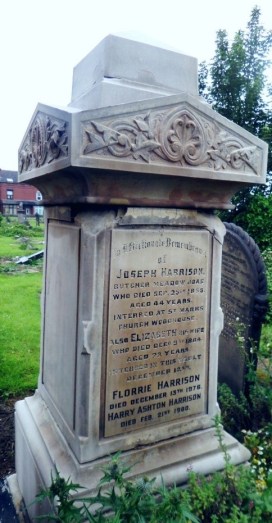
We clearly aren’t the first to make this journey for these purposes, and a wrought iron sculpture shows pivotal historic moments from the graveyard’s history , with ‘V POEM’ on the timeline. Despite directions to the grave we’re looking for, the Harrison family plot isn’t easy to find. The poem had warned us this might be the case: ‘you’ll have to search quite hard’ for it, he writes. We split up, and I find a Byron about thirty yards away (though not ‘three graves on’, as Harrison put it in the poem) and Rory spots ‘Wordsworth, organ builder’ – accurately described in the poem as ‘opposite’ – before turning around to find the Harrison family vault.

Harrison blog 2
The poet’s father and mother – ‘Not Florence and not Flo but always Florrie’ (‘Marked with D.’) – are among others in his family who have been buried in Holbeck Cemetery, Leeds.

And now we aren’t sure what to do. We stand for a moment, reading the inscriptions and both thinking that we can’t just look at it and leave. So, we find a patch of grass that doesn’t seem to be atop anyone’s final resting spot, sit down and watch Tony Harrison’s Channel 4 reading. It’s an odd but comforting experience, and it feels like the right thing to do. At the end, we recall that Harrison does, in fact, invite us to visit, to check on his family plot, to take away the discarded beer cans, and to see whether the ‘UNITED’ spray-painted on the headstone has been left in place. It hasn’t. All the graves have been scrubbed clean of graffiti, though they do all still lean due to subsidence from the worked-out seams below – some, in fact, are completely toppled, while the graves beneath others are beginning to cave in.

Before we head back, we jump the graveyard wall to have a wander down the streets of back-to-back terraces Harrison knew as a boy, and look out at the view of Elland Road, where Leeds United ‘disappoint their fans week after week’ – now obscured from the hill-top graveyard, at least at this time of year, by a line of trees. A corner shop, the proprietor of which is a Patel, is open for business (though this is ‘K. Patel’, not ‘M. Patel’, as in the poem); children home from school ride bikes in the street rather than booting a ball at a tree; a bedraggled stray cat lounges on the roof of a car, making the most of the sun that has finally appeared, close to where scaffolding climbs one of the terrace ends. It feels as though not much has changed since Harrison’s 1984 return visit. In some ways, it hasn’t.

At the end of the day we stop at a service station just outside Leeds, in need of a caffeine top-up. It’s humid and the sun has come out properly, so we sit outside and chat about the poem, the graveyard, my research, while a few yards away a man in a grey t-shirt smokes. When we head to leave, he stops us, and asks if either of our surnames is Harrison. His is, but he ‘ain’t related to no poet’. He looks a lot like a younger Tony, though, and we go, wondering whether it is wrong to feel we might have just met the alter-ego from the poem.

Tuesday Shannon Goacher, NTU MA Creative Writing student 2016-17, and current M4C doctoral candidate