The Unconventional-Conventional Process

John Lewell graduated from NTU’s BA Creative Writing in 2023, with First Class Honours, and is now set to graduate from the MA Creative Writing with Distinction this winter. This blog post is adapted from part of his final assignment for the MA, in which he reflected on his development as a writer.

Searching my heart, mind, and soul, I realise that writing is a journey of discovery— guiding me down paths hidden from the five senses, revealed only through the process, often occurring when I am in a state beyond conscious awareness. Most believe one needs to think to write, but that hinders the flow for me. I drift on a shimmering radio wave, surfing through the universe along streets where memories, emotions, and people mingle, waiting to be picked up, spun around, and woven into a scene. Do I know who this will be, or consider where they will arrive, or when? Nope. As Chris Martin from Coldplay said, ‘Wherever songs come from,’ while looking at the sky and pretending to be all intelligent and artisanal. Good writing, great writing, sensational writing appears. Thinking happens long before the act: in childhood, when you’re about to get your face kicked in; or as a teenager, when you’re scared to tell your friends that you lied about losing your virginity; or when you become a man and realise you’re still that little boy, petrified, waiting for a beating. Mum, Dad, siblings, friends, enemies, hate, love, lust, depression, water, beer, drugs, women, and again love—all spin down the funnel leading here. I don’t believe all can reach this place, or their equivalents of it. 

It helps to know where a comma goes and all that stuff, but words are the destination of this ride. In university, I had to learn all that, and fast, and others inadvertently made me feel small and inadequate with their academic and literary skills. But I noticed something that gave me faith: I loved writing, lusted after it. And not all had that look in their eyes. This is a hunger born of years of intellectual scarcity, a famine of the cerebral. So, I gorged: Lawrence, Bukowski, King, Liu Cixin, Tolkien, Dan Brown, Dahl, Hemingway, Dickens, and so on. I said, looking across a library, ‘I wish I had the mouth and stomach to devour every page’. When I wrote, and by osmosis, I took on traits of these magnificent authors, and I imagined them with the hunger, which made me feel part of a team, a team that never met on pitch or court. Most dead. But I connected with them and watched them write. Suffering and rejoicing. For I believed they knew what it takes, what one goes through to come out the other side, a writer!

Spending every day writing, I locked myself away in a concrete-roofed, bare-bricked shed. I liked that it resembled a prison cell, making me feel captured, contained. If King can write thousands of words a day, if Bukowski wrote authentic, structured dialogue, if Liu Cixin writes from the Chinese Revolution to the end of time, then I want to. I respect two types of people above all others: writers and boxers. Both get hit and hurt. But both fight back: regardless of the towering mountain of an opponent before them and even if they don’t beat that beast, Ivan Drago, they will die trying. Bukowski, a pissed and perverted pauper (most of the time), kept a spark, even when homeless and destitute, when getting old without success, because he knew that ‘a spark can set a whole forest alight.’ And that’s why I continued. And believed, not because sane men told me it’s impossible, but because insane writers and fighters showed me it was.

After the writing beats me up, it’s time to give it a proper thrashing back. The best writing deserves a good blitz. And you watch and wince as a beautifully crafted poetic passage is torn from the carcass. Often, it’s a cake with too much sugar, not enough cream, and a poor consistency of chocolate. The cherry sits patiently, and a writer, a true writer, never feels that the cake deserves the cherry to sit on top. Usually, it’s for another chef to arrive. ‘Enough is enough,’ they say, and you listen, and they look at your daft overzealous eyes and place a hand on your shoulder. ‘It’s time to let go.’ And you nod, a tear welling. ‘So put the bloody cherry on the cake,’ they shout. And you do, but you never think that cake is worthy.  

Inconclusive Conclusion! Unconventional in the sense that some seem to have to think long and hard about what they write, and I don’t. Conventional when editing, sort of, because the flow can arrive, and I forget I’m editing, and the editing becomes an extension of the writing process. And so, I must edit another day – because when it takes you, it bloody takes you.

The Comparison Trap

Outstanding (our word, not hers!) NTU third-year BA Creative Writing student Tilly Hollyhead writes candidly and beautifully about overcoming feelings of inadequacy.

A student with curly hair and glasses smiles while holding a publication titled 'EPOCKE', a Nottingham Trent University student magazine.
Tilly at the launch event for the BA Creative Writing ‘Magazine Publishing: Concept to Dissemination’ module.

After nearly three years at university, I expected I would have shifted the more damaging attitudes that I had towards writing. In particular, I thought that I would have stopped comparing myself to other writers by now. Yet here I am, writing my final blog post on the cusp of graduation, with my attitude still very much the same. And no, this isn’t a post full of doom and gloom. Not at all.

I have always been acquainted with a feeling of inadequacy, a tendency to compare myself detrimentally to others. It started in primary school, my head filled with fantasies and my social skills augmented by what I now wonder might be undiagnosed autism. I had no idea what made me ‘different’. I flip-flopped between thinking there was something wrong with my classmates, and thinking there was something wrong with me, something that stopped me from learning the invisible rules they all seemed to understand. Thankfully, they weren’t the harshest judges in the world.

Then secondary school came along, and I began comparing myself to new sets of classmates, now with hormones and newly emerging anxiety added to the mix. I tried to do what they did. It all seemed very simple: tuck your jumper in at the bottom, roll up your skirt, find a cute hairstyle, and suddenly you have friends. It will come as no shock to anyone that none of that worked out.

I know that this has little to do with writing, but it’s important that you know that, while I was very much aware of my social flaws, my worries never extended to my use of words. They were original. They were creative. They were untouched by those who seemed so much better than me at some other things, because nobody else in my immediate social circle seemed to be a writer.

The process was sacred, in a way, until I joined NTU to study Creative Writing more formally. My arrival to a new social scene, and my surprising success in garnering a dozen friends in the first week, quickly built up a sense of confidence that I wasn’t aware I could have. Armed with my words, and my maiden attempt at writing a novel, I stepped into my first workshop thinking that everything was right with the world. What I didn’t account for was the fact that there would be so much talent around me. On my left sat one of the best prose writers I have ever known (a description I’m sure she’ll deny), and on my other sat a poet who had in me in awe of what he could do in a genre that I had thought I hated. In comparison, my words were child’s play, my musings those of someone who lacked fundamentals. They were not good enough and, suddenly, the work that I had deemed so sacred was nothing more than slop in my eyes.

As I made clear at the beginning of this post, this was an attitude I have never quite put to bed, even after seeing how much I’ve improved. I now see myself as a decent writer who has done just enough. The praise I give to my work is sparing, at best.

I suppose the logical thing to do now would be to tell you about my advice about how to get over this feeling, which I know is not uncommon, and I will never shy away from sharing whatever insights I think I have. I have more experience now, and much more ahead of me. I would not be myself if I did not try to use that to help others make their journey towards writing a little bit easier. However, nothing has banished these thoughts from your brain.

There will be a few people out there ‘blessed’ with a comparative lack of self-consciousness. The majority of us are not so lucky. I can preach endlessly about how writing is not a race. There is something amazing to be found in conversations between writers. They often bring out a sense of community that restores a bit of faith. You’ll see glimpses of humanity in the feral creatures slumped behind laptop screens or slaving over sheets of paper, through their ability to help others and themselves at once – writers aware of the metaphorical miles upon miles they must travel in pursuit of improvement. In a writing community, like the one I’ve found here, the struggle is made more bearable because other people are going through the same things. A writing community is invaluable, I’ve learned.

And I have two other pieces of advice. The first is something simple: ask yourself if you are trying your best.

And when I write ‘ask yourself’, I do not mean pondering the question for a second before going about your business as if nothing has changed. I mean taking fifteen minutes at the end of the day to sit down. Make a list of your accomplishments if you need to, whatever it will take to look back on your day. Of course, it may be scary. It’s never pleasant to be faced with the possibility that you may not be spending your time in the most productive manner.

Which leads me nicely to my second piece of advice: give yourself three goals that you can work towards.

Notice how neither of these titbits involves other people? I had a revelation when writing my dissertation. I was gritting my teeth, trying to get through April while working shifts at my part-time job, and working hard to an imminent submission deadline. Every day, to avoid getting myself stuck in a spiral, I set a list of four tasks that I would have to complete. There was satisfaction in crossing each one of them off. Before I knew it, my thoughts about how well other people were doing, how some had already submitted their final copies, had escaped my mind. In its place was pride at accomplishments, and I think every writer deserves to experience that. Every day, you take one step forward, get a little closer to achieving your goal: your book or poem or screenplay.

There will be days when the list is not enough, where your goals will seem too small. That’s the beauty of it, though. You can push yourself forward, and try even harder, not because you want to keep pace with others but because you have decided it is time. You control the pace of your journey, no matter how fast the world or the people in it seem to be moving around you.

The comparison trap is easy to fall into, even easier to stay in, and hard to escape. You’ll find that writing is much more enjoyable when you’re only concerned about the words you have put on the page.

RELEASE THE SHACKLES!

Following our recent post by Laura De Vivo, another final-year BA Creative Writing student, CLAIRE SUZANNE, discusses her own experiences of writing a monologue and watching it in performance.

Claire (second from right) with fellow Creative Writing students (L-R) Laura De Vivo, Alessandra Leone, and Jamie Brown, at Metronome.

Always keen to make the most of opportunities provided by NTU, earlier this year I took part in a monologue writing workshop hosted by Sara Bodinar, a professional scriptwriter. Unlike most students, I attended online, so I didn’t benefit from the full workshop experience. Still, I decided to take on the challenge to write a monologue to be performed in a collaboration between NTU and Nottingham Actors’ Workshop.

Initially, my mind was as blank as my computer screen. I have drafts of novels, short stories and blog pieces cluttering my hard drive, but no monologues. Although we were given instructions – main character, three act structure – the page remained stubbornly blank on that first day. Disheartened, I decided to try again the next day, and managed to force out a story, but when I read it back it sounded sterile. My heart wasn’t in it, and this was immediately clear. It had no depth. It was a repetitive rant. I pressed delete.

With a familiar blank page glaring at me again, and only 24 hours before I was due to meet Sara in person for one-to-one mentoring, I had no choice but to freewrite. I closed the door, removed all background noise, and somehow managed to get into the zone.

I should mention that this is how I draft most of my fiction. I never plan, but I usually have at least some idea of a theme beforehand. This time, I had no idea what would come out: I just let my mind unleash whatever it wanted. What emerged was something I’d never written about before, something deeply personal that I rarely talk about openly. And this is how ‘Nearly Normal’, as I called it, initially came into being.

 Writing it was like therapy, unleashing inner frustration. When I met Sara in person, I sat on the opposite side of the table, shoved the printout towards her, and looked away in pure embarrassment for showing a stranger something so personal on our first meeting. Then: ‘I love it’, she said, smiling.

Of course, early drafts are never perfect, and work still had to be done, but her feedback was extremely encouraging. Not only did she tell me it was funny and flowed well, but she also told me it was very ‘current’. Little did I know I’d written about a subject that, after a lifetime of being dismissed, people were finally beginning to talk about.

Then she gave me the ultimate task: she challenged me to convey an entire neurodivergence in one page. So I went back to freewriting, and one hour later it was done. As simple as that. Dare I say it was easy? I think so, for once. The words had clearly been desperate to escape for years, and flew out like bats from a cave at dusk.

I sent it back for the actors to audition, received a congratulations e-mail from Sara, then heard nothing more until 23 April when it was performed by a wonderful actress at Nottingham Contemporary.

Luckily for me, my monologue was the first to be announced, so I didn’t have to endure a nervous wait. That didn’t make it any easier to hear my innermost thoughts being read out to a room full of strangers, though. I could barely look, and sat with my head in my hands, looking out between my fingers. But the actress clearly understood the part and did a brilliant job, and it was great to have validation when my amazing friend and partner in writing, Laura De Vivo, said ‘That’s you through and through!’

Freewriting (or not planning), a technique developed originally by Dorothea Brande, is endorsed by many writers I admire, such as Stephen King – and now also by me, a little writing enthusiast with big dreams. I feel my creativity has be unlocked. If I plan too much, I get a mental block: logic intervenes, and creativity is suppressed. Not thinking consciously enables me to tap into that little piece of creative paradise and allow the words to tumble out, like being a little tipsy and suddenly having an increased propensity to socialise! It’s like my imagination is locked in a different section of my brain, chilling with my confidence and social skills. My imagination, though, hasn’t been given a life sentence; my imagination can be released, and the key to it is freewriting.

Opportunities can follow one another, too. Since I began drafting this very blog post, I have been asked to read the monologue at the WRAP anthology launch on 21st May. Now, I’m certainly no actress, and reading on stage still terrifies me. But what is life without challenges? Bring it on!

GET UP, GO OUT!

Leah Jackson, a first-year BA Creative Writing student, went to Paris and Florence, and came back full of ideas.

Many writers tend to struggle with ‘writer’s block’ – it is even the subject of a recent post on this blog. This term may be used when a writer feels lost and insecure in their ideas and projects because of a lack of motivation and inspiration. However, I believe this need never be permanent, as I have discovered a way to combat it: go and see something new, if you can!

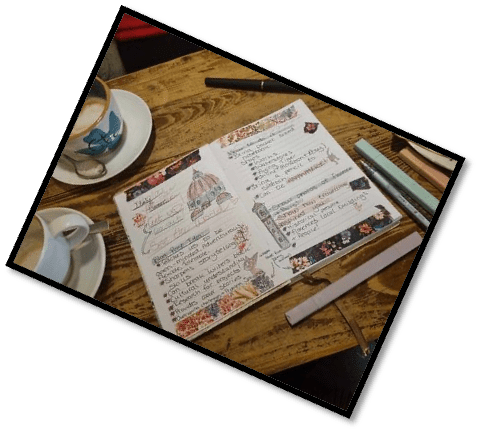
Throughout 2023, I was very grateful to find myself experiencing lots of opportunities to travel. I visited Paris with my college friends in February, and saved up my money to visit Florence for a week in December with a close family member. Every time I was traveling to a new area, I noticed my inspiration was like a bouncy ball of energy in my head, whizzing around full of creative ideas. I had never received that kind of inspiration when staying in my safe university hall bedroom). Breaking out of my comfort zone filled me with refreshing and exciting ideas I would never otherwise have added to my writing journal. Not only that, but it was also helpful to my research for my writing.

When I travelled to Paris, I was captivated by the beautiful city and the fashionable people I walked past. The architecture was extravagant compared to what I was used to. I found myself writing a lot of thoughts down in my journal during my time there. The building in this photo got me thinking creatively: I wondered whether this was an apartment building, and if so, who might live there? Is that person good? What is their occupation? Do they ever leave the building?

I hadn’t travelled outside of the UK since the age of eight, and I remember being scared at first to leave the country without my family. However, I soon found that it transformed my mind to become more flexible, adventurous and open to understanding other ways of living, and I wasn’t scared anymore, just eager to explore. Writing in an unfamiliar but gorgeous city helped me to sharpen my storytelling skills and experiment with unique characters based on strangers I met or observed. Looking back, these characters were the most authentic and unique I had ever written. Writing had become exciting again.

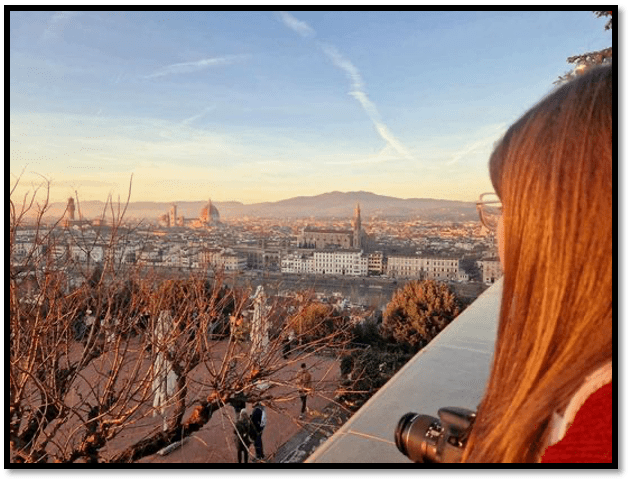
I had been most comfortable writing scripts in the genre of dark comedy. However, when traveling to Florence, I found my new love for writing romance when seeing the historical sculptures and magnificent Florentine buildings. I had never found these types of romantic ideas before anywhere else.  The famous historical geniuses that had built and lived in the breathtaking city also left me questioning what life may have been like here during the Renaissance.

My mind was full of curiosities. Did Leonardo Da Vinci used to sit where I am sitting and think about his next painting? What was Michelangelo thinking when sculpting his famous David? Was it painful work? What was it like to be a member of the Medici family – or one of their servants? Thinking about this made me realize history can also provide a lot of inspiration. Traveling to Florence helped me to gain inspiration for characters and experiment with a new genre I had never tried writing in before.

If you ever find yourself lost for ideas, then, I strongly recommend pushing yourself to break your comfort zone, to widen your mind to what the outside world has to offer. This doesn’t have to involve traveling abroad – it could be going for a walk to your local cafe or nearby forest, traveling to a part of your country you’ve never visited before, or going out of your way to meet new people you would never find in your usual friendship group. By doing this you are improving your writing skills with new knowledge. If you are in Nottingham, you have wonderful places to explore all around you. Getting yourself out there, whether it is your back garden or another country, can always help refresh those creative thoughts and stave off the dreaded ‘writer’s block’.

Here are some tips that can help you keep these new special ideas safe:

  • Always carry a pocket or bag-friendly notebook with you, I usually carry around an A5 journal and this can fit in my small satchel bag! This makes it easier to travel with.
  • Always bring a pencil or a pen. If you would like to make it more fun, some colourful highlighters or different coloured gel pens, stickers and washing tapes can be used to spice up your pages in your writing journal. (This can also make the ideas more memorable for you!)
  • A small laptop or iPad can also be used if you prefer to type up your ideas instead of writing them traditionally. I prefer the latter, but we’re all different.
  • If you do ever find yourself having a boost of inspiration and you happen to have forgotten your notebook and stationery, you can obviously also use your phone’s ‘Notes’ app, and jot them down in your journal later.
  • Buy yourself a professional camera or use your phone camera to capture whatever inspires you! Then you can always come back to that photo and brainstorm even more ideas. The photos in this blog post have mostly been taken on my recent travels. Using photography to boost inspiration can also be effective.