LEARNING THE CODE

Claire Suzanne, a mature part-time student on the BA Creative Writing at NTU, reflects on learning to code as part of her degree, and how it has opened up new kinds of writing for her.

When I found out I would need to learn coding to make an interactive fiction game this academic year, I panicked. Being from the era where we were lucky to have more than one computer in a classroom, and who had not since taken much more interest in computers than necessary, coding certainly was not something I had experienced before. I remember seeing the ‘programmers’ in my old workplace looking at a screen full of symbols and seemingly speaking a different language. I never understood exactly what they were doing, only that somehow it made the website look nice.

Most of my fellow students on the BA Creative Writing are about twenty years younger than me, and I assumed they would all know how to do it, that they had been taught in school. They hadn’t, and I was surprised when a lot of them said they also didn’t know anything about coding. What a relief – I wasn’t going to be the class dinosaur after all! I was paired with another student who was as nervous about the prospect as me, and we set to work understanding how to create a game.

Once I understood the symbols are the computer’s language, and that by learning to code I would be instructing the computer and telling it what I wanted it to do, it all started to make sense. Code was its command. All I would have to do was learn the language and make the orders.

Now, let’s be clear: I won’t be strutting off to Silicon Valley any time soon. But now I understand the basics, the actual coding seems pretty self-explanatory. The concept makes sense!

The game we made has a branching narrative, meaning the user has choices to make, each leading them to different sections of the game, and along the way they can win points – a bit like the old mystery books I grew up with, in which I could create my own versions of a story depending on which pages I turned to.

Once I’d learned the coding language, the next step was to build the narratives. Luckily, we were able to use Twine, interactive fiction software that lays the game out in the form of a flow chart to remind you what leads to where. It can get confusing, though: one error and the whole game can go wrong. It took a lot of concentration to think it through, to work out how to overcome problems and find errors.

There were days when I just wanted to walk away, I’ll admit, yet there were others when I could get stuck right in, solve the problems, and feel satisfied I had achieved something.

In the end, the two of us created our own version of the game, meaning we both learned to code. Then we took elements from both of our games to create a final piece which we completed and presented in December to a client, Nottingham Open Spaces, as part of our ‘Freelancer’ module on the degree.

As someone who came to university with very outdated computer skills, I am extremely proud of myself for learning to do this. If anyone had asked me in my first year whether I would make a game by the end of my degree the answer would’ve been a resounding ‘no’. I wouldn’t have wanted to, either. I was reluctant to upgrade my skills and wanted to learn nothing more than how to improve my writing so I could hide away in my home office and write fiction. But now I have learnt there is so much more to the writing world than I’d known about previously, and there is no reason forty-year-olds who have run from computing and who want to write can’t also have up-to-date digital skills.

The game was based on children visiting Wollaton Park, so I got to test it out on my seven-year-old who enjoyed winning points and getting a reward from the gift shop at the end. She now can’t wait to visit the park for real over the holidays.

The Comparison Trap

Outstanding (our word, not hers!) NTU third-year BA Creative Writing student Tilly Hollyhead writes candidly and beautifully about overcoming feelings of inadequacy.

A student with curly hair and glasses smiles while holding a publication titled 'EPOCKE', a Nottingham Trent University student magazine.
Tilly at the launch event for the BA Creative Writing ‘Magazine Publishing: Concept to Dissemination’ module.

After nearly three years at university, I expected I would have shifted the more damaging attitudes that I had towards writing. In particular, I thought that I would have stopped comparing myself to other writers by now. Yet here I am, writing my final blog post on the cusp of graduation, with my attitude still very much the same. And no, this isn’t a post full of doom and gloom. Not at all.

I have always been acquainted with a feeling of inadequacy, a tendency to compare myself detrimentally to others. It started in primary school, my head filled with fantasies and my social skills augmented by what I now wonder might be undiagnosed autism. I had no idea what made me ‘different’. I flip-flopped between thinking there was something wrong with my classmates, and thinking there was something wrong with me, something that stopped me from learning the invisible rules they all seemed to understand. Thankfully, they weren’t the harshest judges in the world.

Then secondary school came along, and I began comparing myself to new sets of classmates, now with hormones and newly emerging anxiety added to the mix. I tried to do what they did. It all seemed very simple: tuck your jumper in at the bottom, roll up your skirt, find a cute hairstyle, and suddenly you have friends. It will come as no shock to anyone that none of that worked out.

I know that this has little to do with writing, but it’s important that you know that, while I was very much aware of my social flaws, my worries never extended to my use of words. They were original. They were creative. They were untouched by those who seemed so much better than me at some other things, because nobody else in my immediate social circle seemed to be a writer.

The process was sacred, in a way, until I joined NTU to study Creative Writing more formally. My arrival to a new social scene, and my surprising success in garnering a dozen friends in the first week, quickly built up a sense of confidence that I wasn’t aware I could have. Armed with my words, and my maiden attempt at writing a novel, I stepped into my first workshop thinking that everything was right with the world. What I didn’t account for was the fact that there would be so much talent around me. On my left sat one of the best prose writers I have ever known (a description I’m sure she’ll deny), and on my other sat a poet who had in me in awe of what he could do in a genre that I had thought I hated. In comparison, my words were child’s play, my musings those of someone who lacked fundamentals. They were not good enough and, suddenly, the work that I had deemed so sacred was nothing more than slop in my eyes.

As I made clear at the beginning of this post, this was an attitude I have never quite put to bed, even after seeing how much I’ve improved. I now see myself as a decent writer who has done just enough. The praise I give to my work is sparing, at best.

I suppose the logical thing to do now would be to tell you about my advice about how to get over this feeling, which I know is not uncommon, and I will never shy away from sharing whatever insights I think I have. I have more experience now, and much more ahead of me. I would not be myself if I did not try to use that to help others make their journey towards writing a little bit easier. However, nothing has banished these thoughts from your brain.

There will be a few people out there ‘blessed’ with a comparative lack of self-consciousness. The majority of us are not so lucky. I can preach endlessly about how writing is not a race. There is something amazing to be found in conversations between writers. They often bring out a sense of community that restores a bit of faith. You’ll see glimpses of humanity in the feral creatures slumped behind laptop screens or slaving over sheets of paper, through their ability to help others and themselves at once – writers aware of the metaphorical miles upon miles they must travel in pursuit of improvement. In a writing community, like the one I’ve found here, the struggle is made more bearable because other people are going through the same things. A writing community is invaluable, I’ve learned.

And I have two other pieces of advice. The first is something simple: ask yourself if you are trying your best.

And when I write ‘ask yourself’, I do not mean pondering the question for a second before going about your business as if nothing has changed. I mean taking fifteen minutes at the end of the day to sit down. Make a list of your accomplishments if you need to, whatever it will take to look back on your day. Of course, it may be scary. It’s never pleasant to be faced with the possibility that you may not be spending your time in the most productive manner.

Which leads me nicely to my second piece of advice: give yourself three goals that you can work towards.

Notice how neither of these titbits involves other people? I had a revelation when writing my dissertation. I was gritting my teeth, trying to get through April while working shifts at my part-time job, and working hard to an imminent submission deadline. Every day, to avoid getting myself stuck in a spiral, I set a list of four tasks that I would have to complete. There was satisfaction in crossing each one of them off. Before I knew it, my thoughts about how well other people were doing, how some had already submitted their final copies, had escaped my mind. In its place was pride at accomplishments, and I think every writer deserves to experience that. Every day, you take one step forward, get a little closer to achieving your goal: your book or poem or screenplay.

There will be days when the list is not enough, where your goals will seem too small. That’s the beauty of it, though. You can push yourself forward, and try even harder, not because you want to keep pace with others but because you have decided it is time. You control the pace of your journey, no matter how fast the world or the people in it seem to be moving around you.

The comparison trap is easy to fall into, even easier to stay in, and hard to escape. You’ll find that writing is much more enjoyable when you’re only concerned about the words you have put on the page.

RELEASE THE SHACKLES!

Following our recent post by Laura De Vivo, another final-year BA Creative Writing student, CLAIRE SUZANNE, discusses her own experiences of writing a monologue and watching it in performance.

Claire (second from right) with fellow Creative Writing students (L-R) Laura De Vivo, Alessandra Leone, and Jamie Brown, at Metronome.

Always keen to make the most of opportunities provided by NTU, earlier this year I took part in a monologue writing workshop hosted by Sara Bodinar, a professional scriptwriter. Unlike most students, I attended online, so I didn’t benefit from the full workshop experience. Still, I decided to take on the challenge to write a monologue to be performed in a collaboration between NTU and Nottingham Actors’ Workshop.

Initially, my mind was as blank as my computer screen. I have drafts of novels, short stories and blog pieces cluttering my hard drive, but no monologues. Although we were given instructions – main character, three act structure – the page remained stubbornly blank on that first day. Disheartened, I decided to try again the next day, and managed to force out a story, but when I read it back it sounded sterile. My heart wasn’t in it, and this was immediately clear. It had no depth. It was a repetitive rant. I pressed delete.

With a familiar blank page glaring at me again, and only 24 hours before I was due to meet Sara in person for one-to-one mentoring, I had no choice but to freewrite. I closed the door, removed all background noise, and somehow managed to get into the zone.

I should mention that this is how I draft most of my fiction. I never plan, but I usually have at least some idea of a theme beforehand. This time, I had no idea what would come out: I just let my mind unleash whatever it wanted. What emerged was something I’d never written about before, something deeply personal that I rarely talk about openly. And this is how ‘Nearly Normal’, as I called it, initially came into being.

 Writing it was like therapy, unleashing inner frustration. When I met Sara in person, I sat on the opposite side of the table, shoved the printout towards her, and looked away in pure embarrassment for showing a stranger something so personal on our first meeting. Then: ‘I love it’, she said, smiling.

Of course, early drafts are never perfect, and work still had to be done, but her feedback was extremely encouraging. Not only did she tell me it was funny and flowed well, but she also told me it was very ‘current’. Little did I know I’d written about a subject that, after a lifetime of being dismissed, people were finally beginning to talk about.

Then she gave me the ultimate task: she challenged me to convey an entire neurodivergence in one page. So I went back to freewriting, and one hour later it was done. As simple as that. Dare I say it was easy? I think so, for once. The words had clearly been desperate to escape for years, and flew out like bats from a cave at dusk.

I sent it back for the actors to audition, received a congratulations e-mail from Sara, then heard nothing more until 23 April when it was performed by a wonderful actress at Nottingham Contemporary.

Luckily for me, my monologue was the first to be announced, so I didn’t have to endure a nervous wait. That didn’t make it any easier to hear my innermost thoughts being read out to a room full of strangers, though. I could barely look, and sat with my head in my hands, looking out between my fingers. But the actress clearly understood the part and did a brilliant job, and it was great to have validation when my amazing friend and partner in writing, Laura De Vivo, said ‘That’s you through and through!’

Freewriting (or not planning), a technique developed originally by Dorothea Brande, is endorsed by many writers I admire, such as Stephen King – and now also by me, a little writing enthusiast with big dreams. I feel my creativity has be unlocked. If I plan too much, I get a mental block: logic intervenes, and creativity is suppressed. Not thinking consciously enables me to tap into that little piece of creative paradise and allow the words to tumble out, like being a little tipsy and suddenly having an increased propensity to socialise! It’s like my imagination is locked in a different section of my brain, chilling with my confidence and social skills. My imagination, though, hasn’t been given a life sentence; my imagination can be released, and the key to it is freewriting.

Opportunities can follow one another, too. Since I began drafting this very blog post, I have been asked to read the monologue at the WRAP anthology launch on 21st May. Now, I’m certainly no actress, and reading on stage still terrifies me. But what is life without challenges? Bring it on!

STAGE STARVED

In this piece, NTU BA Creative Writing final year student LAURA DE VIVO discusses her growing interest in writing for performance, and what she learned from developing her monologue, Starved, and watching an actor perform it.

When I came to university to study for a creative writing degree, I hadn’t expected to gain a love for theatre. Nonetheless, in my first year I answered a call from Message in a Bottle Monologues for five-minute pieces on the theme of darkness. I was honoured to receive a spot and my piece, ‘The Demon in my Head’, a personification of my medical condition, found a voice. Then I sat mesmerised on the front row the night it was performed, in awe of the actor, and the fact that he was speaking words I’d written. I almost couldn’t watch, but it received such a positive response that by the time I left the theatre I was hooked on writing for performance.

So, earlier this year, when the opportunity to take part in a monologue workshop and have a one-to-one with the playwright Sara Bodinar came up, I couldn’t turn it down, despite my third-year workload. It was the chance I’d waited for to bring Collette Dubois to life: she had lived quietly for years on my hard drive, waiting for embodiment. Everyone at the workshop approved of her, and that was all the encouragement I needed.  

Collette is a vampire, and unrelatable in many ways, yet she faces a decision we can all understand: what would you sacrifice for love, and how do you battle with its turmoil?

I could barely hold myself still on the tram home, desperate to find my laptop and write – to lift her from the pages of a short story and give her new life, ironic considering she’s been dead for two hundred years.

During my one-to-one with Bodinar, I came to understand more fully that a monologue is a story, it often has three acts, needs foreshadowing and flashback, and is not just a rant by a character at an audience. After our meeting, I finalised the piece, sent it in, and crossed my fingers. I would not see it again until the night of the performance at Nottingham Contemporary. I tried my best to forget about it.

The evening soon arrived and, along with my family, I joined the other writers and supporters. Not knowing the actor who would play Collette, I was unable to give advice on how I felt she should be portrayed. This was an important lesson: was my skill as a writer good enough to ensure her character would shine through without my further intervention? Time would tell.

I rarely do anything without Claire Suzanne, a friend on the BA Creative Writing. Her piece, ‘Nearly Normal’, was the first to be announced. As the actress moved about the stage I could hear Claire in every word: hers was a personal piece. I had approached the task very differently.

More monologues followed. I waited, my hands becoming clammy, and the room felt like it was close to boiling point. Finally, I saw a beautiful woman with sweeping red hair and a claret dress, and I knew in my blood that that was her. The poor man tasked with being a dead body (my piece required it) was also a giveaway, and I laughed knowing what was in store for him. This was toned down from my original script, and for good reason: I’m sure he’d not signed up to be given bruises.

Ria, as I learned she was called, gave a brilliant depiction of a ‘starved’ predatory monster, though not quite how I had imagined her. This meant I had some work to do if Collette was to be portrayed how I had her in my head – though it was also a thrill to see an actor bring her creativity to my creation. It was an honour to have another piece performed, and this has cemented my desire to push my writing career towards the theatre.

After each performance, the writer responsible was revealed to the audience and actors, but we all had to wait until it was over to meet each other. Ria is a wonderful lady and actress and the connection we made was encouraging.

Laura (left) with Ria.

As an aspirational playwright, I find this type of opportunity important. It provides an outlet to help push my words out into the world, and gave me immediate answers regarding what works and what doesn’t.

You also do not know who may be attending events like this, of course, and it only takes one chance meeting to give an idea legs. NTU has been great help and support throughout my BA, and I would not have been exposed to these opportunities without it. As I move towards my MA Creative Writing at NTU, I will be looking for further chances to write for performance.


JEWISH BOOKSELLERS IN NAZI GERMANY: SOME NOTES ON A RESEARCH TRIP

Steve Katon

Last November and December, Steve Katon travelled to Berlin and the towns of Oranienburg and Pirna to conduct research for his Arts and Humanities Research Council Midlands4Cities-funded PhD in creative and critical writing. Here are some of his reflections.

My PhD project looks at the underrepresentation of disability in children’s literature. The creative part involves me writing a novel set in Nazi Germany covering the state-sponsored murder of disabled people which took place under the codename Aktion T4.

Thanks to funding from the AHRC, researching the novel took me to the Jewish Museum in Berlin, Sachsenhausen Concentration Camp and the permanent memorials of the Aktion T4 killing centres at Brandenburg an der Havel and Pirna-Sonnenstein. I talk about these in a blog post that I wrote for Nottingham UNESCO City of Literature to coincide with Holocaust Memorial Day.

Below, I will focus instead on some research I undertook on bookshops that were trading in the period I am writing about, and in particular the fate of Jewish booksellers of the time. The main character in my novel is Friede, a girl with Down’s syndrome, who has been adopted by Bernard, a writer and bookseller, and his sister Dorothy, a doctor. Both siblings are Jewish.

A large part of my visit to Berlin was to help me to build a picture of Bernard’s bookshop and gain insights into the life of a Jewish bookseller in the years leading up to the war. To begin, I therefore visited the excellent Landesarchiv, which holds documents and photographs of the German capital’s institutions, businesses and residences.

I had corresponded with Carmen Schwietzer, the deputy director of the archive, before my visit. When we met in person, Carmen very kindly helped me to identify several Jewish booksellers in the districts of Charlottenburg and Schöneberg that were trading in the 1930s. While at the archive I looked at the original records of these. As you may imagine, many of the files are heavily administrative in nature and, as they were written by biased perpetrators, are not particularly revealing of their crimes. An example below relates to a Jewish bookseller called Willy Flanter, who, even after he had been banned from selling books, still fought to stay in business. The letter on the left shows his tenacity to continue trading by attempting to re-register his business as a manufacturer.

It was a privilege to study this archive. All the same, after many hours of poring through documents, I was keen to get out and explore the streets. And on a sunny Saturday morning I did just that.

A hero of Berlin bookselling is the so-called Lioness of Kurfürstendamm, Marga Schoeller. She started selling literature in 1929 and, though no longer in its original location, her shop is still trading today.

Schoeller, who is not Jewish, welcomed writers, actors, academics and students to her shop, forming, as she called it, the anti-Nazi intelligentsia of the city. She bravely reserved a good stock of banned material in a secret cellar, which was only opened for her most trusted customers. I am almost certain a fictional version of the Lioness will claw her way into my novel. If you find yourself in Berlin, I highly recommend a visit. The staff were friendly and helpful, and I could have stayed much longer than I did. But I had work to do.

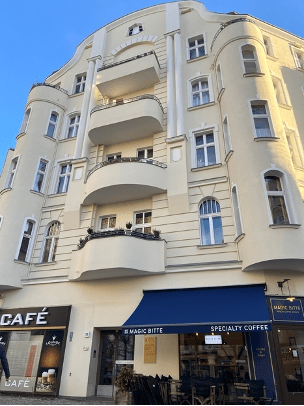
When looking for inspiration for the exterior of my fictional bookshop, the name of one premises leapt out at me: Willy Cohn’s Book Corner, in Schöneberg. I found the location of the shop, which is now a rather nice cafe. Stopping here for refreshments, I imagined how my fictional characters might have inhabited it in the 1920s and 1930s.

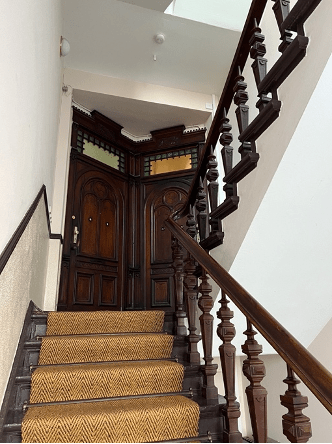
I would have to rely on old photographs to get to grips with the layout of the premises when they were bookshops. But then I got lucky at the address of a 1930s Jewish bookseller called Ernst Hesse. There were no signs of a shop frontage: this is a block of apartments – though the architecture clearly predated the war. I imagine this was Hesse’s trading address and the door to the communal entrance had been left open. Looking inside, I was treated to the sight of an opulent hardwood handrail, some gorgeous interior doors and an original ceramic-tiled floor. Perhaps the inside of my fictional bookshop and the stairs to my character’s apartments will look something like this.

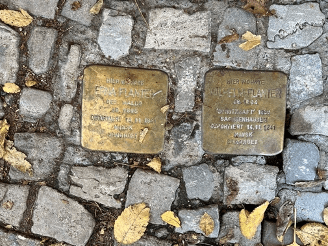
But what of the booksellers who lived in these places? How are they commemorated? There is an ongoing initiative known as the stolpersteines: 10cm square blocks set into the pavement outside the last known residences of victims of the Nazis. More than once, I found at my feet details of how their stories ended. Here are those of Willy Flanter and another famous Berlin bookseller called Arthur Cassirer, and their families.

I will end by saying your German may be better than mine, but if not, it’s perhaps enough to know that the word ermordet, etched into many of these stones, simply translates as ‘murdered’.