Leah Jackson, a first-year BA Creative Writing student, went to Paris and Florence, and came back full of ideas.
Many writers tend to struggle with ‘writer’s block’ – it is even the subject of a recent post on this blog. This term may be used when a writer feels lost and insecure in their ideas and projects because of a lack of motivation and inspiration. However, I believe this need never be permanent, as I have discovered a way to combat it: go and see something new, if you can!
Throughout 2023, I was very grateful to find myself experiencing lots of opportunities to travel. I visited Paris with my college friends in February, and saved up my money to visit Florence for a week in December with a close family member. Every time I was traveling to a new area, I noticed my inspiration was like a bouncy ball of energy in my head, whizzing around full of creative ideas. I had never received that kind of inspiration when staying in my safe university hall bedroom). Breaking out of my comfort zone filled me with refreshing and exciting ideas I would never otherwise have added to my writing journal. Not only that, but it was also helpful to my research for my writing.

When I travelled to Paris, I was captivated by the beautiful city and the fashionable people I walked past. The architecture was extravagant compared to what I was used to. I found myself writing a lot of thoughts down in my journal during my time there. The building in this photo got me thinking creatively: I wondered whether this was an apartment building, and if so, who might live there? Is that person good? What is their occupation? Do they ever leave the building?
I hadn’t travelled outside of the UK since the age of eight, and I remember being scared at first to leave the country without my family. However, I soon found that it transformed my mind to become more flexible, adventurous and open to understanding other ways of living, and I wasn’t scared anymore, just eager to explore. Writing in an unfamiliar but gorgeous city helped me to sharpen my storytelling skills and experiment with unique characters based on strangers I met or observed. Looking back, these characters were the most authentic and unique I had ever written. Writing had become exciting again.

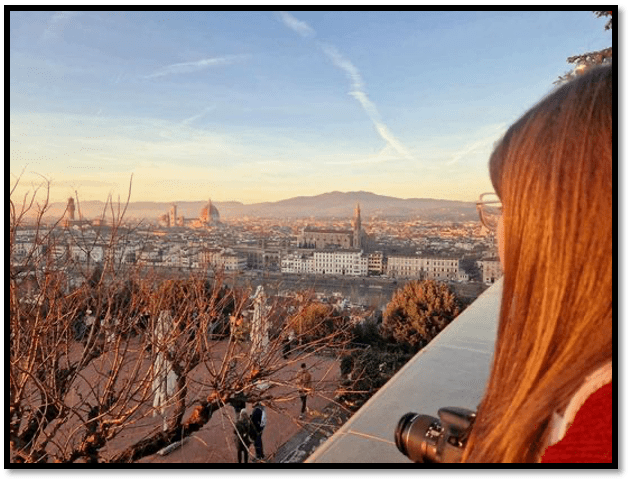
I had been most comfortable writing scripts in the genre of dark comedy. However, when traveling to Florence, I found my new love for writing romance when seeing the historical sculptures and magnificent Florentine buildings. I had never found these types of romantic ideas before anywhere else. The famous historical geniuses that had built and lived in the breathtaking city also left me questioning what life may have been like here during the Renaissance.

My mind was full of curiosities. Did Leonardo Da Vinci used to sit where I am sitting and think about his next painting? What was Michelangelo thinking when sculpting his famous David? Was it painful work? What was it like to be a member of the Medici family – or one of their servants? Thinking about this made me realize history can also provide a lot of inspiration. Traveling to Florence helped me to gain inspiration for characters and experiment with a new genre I had never tried writing in before.
If you ever find yourself lost for ideas, then, I strongly recommend pushing yourself to break your comfort zone, to widen your mind to what the outside world has to offer. This doesn’t have to involve traveling abroad – it could be going for a walk to your local cafe or nearby forest, traveling to a part of your country you’ve never visited before, or going out of your way to meet new people you would never find in your usual friendship group. By doing this you are improving your writing skills with new knowledge. If you are in Nottingham, you have wonderful places to explore all around you. Getting yourself out there, whether it is your back garden or another country, can always help refresh those creative thoughts and stave off the dreaded ‘writer’s block’.
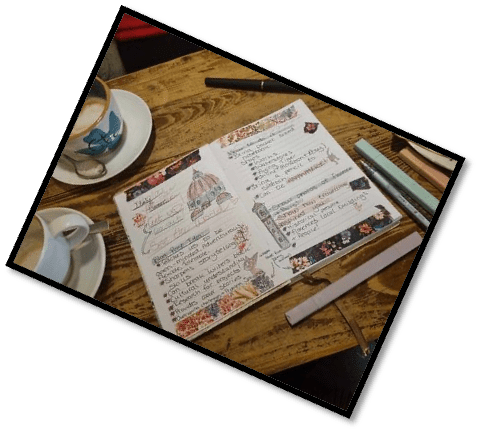
Here are some tips that can help you keep these new special ideas safe:
- Always carry a pocket or bag-friendly notebook with you, I usually carry around an A5 journal and this can fit in my small satchel bag! This makes it easier to travel with.
- Always bring a pencil or a pen. If you would like to make it more fun, some colourful highlighters or different coloured gel pens, stickers and washing tapes can be used to spice up your pages in your writing journal. (This can also make the ideas more memorable for you!)
- A small laptop or iPad can also be used if you prefer to type up your ideas instead of writing them traditionally. I prefer the latter, but we’re all different.
- If you do ever find yourself having a boost of inspiration and you happen to have forgotten your notebook and stationery, you can obviously also use your phone’s ‘Notes’ app, and jot them down in your journal later.
- Buy yourself a professional camera or use your phone camera to capture whatever inspires you! Then you can always come back to that photo and brainstorm even more ideas. The photos in this blog post have mostly been taken on my recent travels. Using photography to boost inspiration can also be effective.

 NOTTINGHAM CREATIVE WRITING HUB