DR PANYA BANJOKO is a poet, archivist of the Nottingham Black Archive, and a research fellow at the University of Nottingham. She recently completed a PhD at NTU. In this fascinating blog post, she discusses reading, the values it brings to society, and the risks of low literacy.
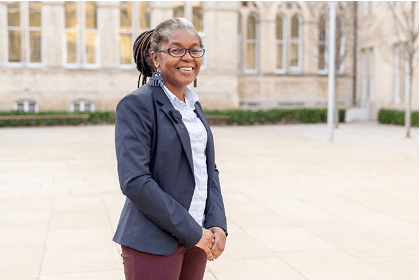
I can recall stumbling over words and wanting very much to be a fluent reader. My desire to become a reader and being unable to do so weighed heavily on my infant shoulders. I can’t remember being taught phonics at school, but then as a second-generation child of economic migrants I was subjected to a substandard school with less-than-ideal teachers. Back then, what now seems like a hundred years ago, I thought I’d never master the art of reading: it seemed exclusive, something way out there in the land of unicorns and fairies.
My shortcomings were temporarily bridged by reluctantly leaning on my brother, eighteen months older and wiser than me, who was my golden ticket to deciphering words. This worked for a short while, until he grew tired of my annoying requests for help, and so the pressure to read independently deepened. Reading for me was attempting to decipher words in a comic book, and I was expected to know how to decode words by magic. We didn’t have books in my home; however, my mother did provide us with weekly subscriptions to a few popular comics, The Beano, The Dandy and Donald and Mickey. This is my first memory of coming face to face with words and I learned to read by remembering them. It was slow, and painstaking, and unbearable, but once I caught on, I began to enjoy the act, and eventually fell in love with it.
Although books was never a feature in my childhood home, I tell everyone willing to listen that I did own one book. It was gifted to me by my godmother, the late Myrtle Thompson, and was a book of prayers; it rhymed and had a predictable structure which made it extremely enjoyable. What I didn’t know then was that the rhymes were teaching my brain how to remember, teaching it about how words fit together, how sentences are structured, and how meaning is conveyed through language. I spent endless hours sitting crossed-legged on my bed reading the prayers in solitude. It felt precious owning a book and I guarded it judiciously in a house filled with rambunctious siblings, lest it should come to harm.
I never saw either of my parents thumbing through the pages of a book, and was surprised when recently sorting through my father’s belongings to find two books that he had owned. The first, The Practical Handyman by James Wheeler, published by Odhams press in 1930, contained within its yellowing pages everything from a list of tools and their uses to instructions for building a glass-roofed veranda. The second, How to Write, Think and Speak Correctly, by the same publisher, and edited by C. E. M. Joad in 1939, held within its equally musty pages tips on the art of thinking, correct speech, good English and good style. What I found even more interesting was an article folded inside the front cover, a newspaper clipping from The Sun dated Monday June 6, 1988. The headline read, ‘Touchy O’Neal storms out after “racist slur” bust up’. The article refers to the Mississippi born singer Alexander O’Neal storming out of a London restaurant after accusing a waiter of being racist. O’Neal, celebrating the success of his newly released single, “The Lovers”, was at the restaurant with the Harlem Globetrotters, when the waiter referred to them as “boys”. So, between the cover of a book designed to teach my father how to become a perfect English gentleman was the stark reality that this might somehow be unattainable for him. My father’s books tell me a lot about him as a first-generation economic migrant from the Caribbean making a life for himself in 1960s Nottingham. He spent his entire working life down the pit. I can see how he wanted to improve himself, what he thought he needed to do to achieve this, and how he believed the answers to belonging could be found in non-fiction books. I wonder, had he picked up a book of fiction, whether that would have opened up the skies for him.
I asked my eldest granddaughter, who has just turned 16, to tell me her reading story. She said, “I don’t know how I got there, I just remember reading”, and I gave myself a pat on the back for breaking generational curses. As a mother, I flooded my children with books and instilled an ethos of reading being as important as the air we breathe. Reading was part and parcel of their daily routine growing up, and so it made complete sense that my granddaughter didn’t know how she came to be a reader – she had always been immersed in books. It was as though I was asking her to recall taking her first breath.
Reading runs alongside everything I do now, as an academic, an artist, and the keeper of an archive. Books are my best and only companion on long train journeys or travels abroad. I read Chinua Achebe’s Things Fall Apart, penned in 1958, in a secluded spot in Jamaica, and followed it up with William Golding’s Lord of the Flies (1954). While travelling to Paris by train I devoured Dan Brown’s The DaVinci Code (2003), and completed it while sitting outside the Louvre in Paris. But reading is more than a travel companion, it has also been my salvation. After a serious breakup I took to bed with a book and stayed there for two weeks reading literary fiction, and when I emerged I felt better, much better. One of my favourite pastimes is sitting in a café with the squiggly notes of jazz music playing in the background, sipping coffee and nibbling lemon drizzle cake, with a book of poetry. I swear that it is the best way to read Langston Hughes’s debut collection The Weary Blues (1926). Without a doubt reading is a wonderful skill to possess and an enjoyable thing to do, yet here we are as a UNESCO City of Literature with so many excellent writers, past and present, including literary greats like Byron, Sillitoe and Lawrence, to literary advocates and activists like George Powe and Leanora (Lee) Arbouin, and we have a serious literacy problem.
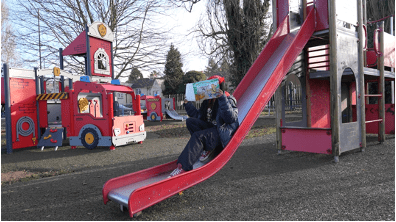
Data produced by the National Literacy Trust Nottingham Hub in 2018 shows that nearly 40% of Nottingham children fall short in communication, language and literacy areas of learning in reception year, and the National Literacy Trust’s annual survey on children’s book ownership shows that one in ten children in the UK (in 2024) don’t have a book of their own. Without the educational infrastructure in place, children are likely to suffer with their learning confidence and wellbeing and are much more likely to struggle with their GCSEs and be unemployed by their 30s. The Department for Education in 2023 contended that being unable to read narrows the range of work and life opportunities a person can access. Even more worryingly, in my opinion, is the threat of radicalisation that can occur when people do not have the skills to research facts for themselves. An infamous waning president of a once vibrant but now declining state once said “Smart people don’t like me”, and remarked, “I like dumb people”. A low-literacy population makes bad decisions and can potentially set us up for problems in the future. We want educated conversations, thoughtful and critical thinkers, and deep listening with dialogue, not citizens following authoritarian leaders blindly.
The low literacy rate in Nottingham is disheartening, then, but it is not unsalvageable, and I believe we can harness this year, the National Year of Reading, to toss books around like cabers. This is the moment to push further and engage as many reluctant readers as possible to pick up a book, and to encourage those who understand the benefits of books to gift them to others. And there’s plenty going on in the city to support literacy, including Literacy Champions, and book giveaways such as Nottingham UNESCO City of Literature’s (NUCoL) Big City Reads free book giveaway campaign for young adults, and we need to encourage more children and their parents to step into our fantastic libraries.
As a writer who came to reading in a haphazard way, I’m adding my two pennies into the pot, for what it’s worth. I’m using my recently acquired skills as a poetry filmmaker, courtesy of Arts Council England’s Developing Your Creative Practice (DYCP) grant scheme, which afforded me time to develop my page poetry into digital poetics, to keep the topic of books and reading current. The DYCP has not only allowed me to position my work in different spaces such as the EDITION26 exhibition at Backlit gallery, which featured artists presenting two works made at different points in their practice, and being one of the winners worldwide to have my poem “Table for One, Please” featured on the Poetry Archive Now website, but it has also led to me becoming a StoryArcs Research Fellow undertaking a placement with NUCoL to mark their tenth anniversary. To keep reading and books on the agenda I created two short films as a resource for NUCoL. The first, ‘10 Ways To Read A Book’, asks audiences to think about where they like to read in a fun way. The second, ‘Building A Better World With Words’, mixes archival images from NUCoL’s tenth anniversary with recent data on what the reading landscape looks like in our city. The aim is to make literacy data relatable, accessible and personal. Both films are held together with a bespoke poem penned by me.
Reading is imperative for expanding our horizons, for building our empathy and confidence, and for supporting us on our journeys through life. Reading is more than just words, it is endless skies, and we need more initiatives to engage and support reluctant readers to soar. My first book was gifted to me by my godmother, and it left a lasting impression on me and is perhaps one of the contributory factors that led to me becoming a lifelong lover of poetry and subsequently an award-winning poet. We need to continue to cultivate a generous spirit when it comes to reading in this city, and I take this challenge personally because Nottingham is my city, the place where I was born, where my children were born, and my grandchildren too. I have invested in this city; I want to see Nottingham do well. So, let’s all be advocates for books and encourage more people to engage with reading, especially the younger generation, and let’s start talking more and more and more about books, about reading, about our own stories of how we became readers, and most importantly what we love the most about books.

