NTU BA English student and young writer Emilie Holmes reflects on a competition win for her flash fiction (which you can read in a link below), and on her continuing journey as a writer, in this thoughtful and candid blog post. You can find her on Instagram: poetrybyemilieholmes.
When I found out about the Universite de Lille flash fiction competition I had already been working on ‘Summer Gardening’, the piece I submitted. I thought it was a perfect fit because the prompt was ‘independence’ and my story conveyed the fine line between self-determination and isolation. However, when I found out it had won I was surprised, and not only for the expected reason. I’d submitted it over six months earlier, and if I’m being honest I had completely forgotten that I’d entered.
You can read the story here: Emilie-Holmes.pdf (flsh.fr)
It follows a girl experiencing a groundhog-like day, tormenting herself by being a creature of habit, unable to leave the comfort of her home. Throughout, the narrator is associated with fragility: when the sun follows her she moves her chair to face the wall, implying she doesn’t want to be perceived, not by daylight, not by anyone. The depiction of fragility only builds towards the end, as she’s compared to glass. In the beginning, the girl places her last tea bag into the only mug she owns, which acts as a catalyst for the ending as she realises she has run out of tea, which forces her reluctantly to leave her home and ultimately return to civilisation. I also used her connection with nature to allude to returning to oneself before going back out into the world: we are nothing if not from nature. Instead of listening to music, which she seems to keep skipping, she chooses to ‘listen to the hum of the cricket instead and share flowers with the bees’, portraying a reconnection with nature and life itself through sensory images and grounding techniques. The ending fuels her need for companionship and resilience: ‘It’s so remote here I wouldn’t be able to catch an engine even if I closed my eyes’, she says, insinuating how closed off from the world she is, to the extent that she can’t even hear humanity, let alone see it.
Nottingham Trent University has so many opportunities for young writers, which is very beneficial for English students like me. Since 2021, NTU and Université de Lille have partnered on student-led research trips as part of an initiative by NTU Global. The Flash Fiction competition is a result of such trips, aiming to provide publication opportunities for students writing in French, Spanish and English. Selected work this year is published in an anthology co-edited by Suzanna Bray (Lille) and James Walker (NTU), with competition winners voted for by seven independent judges.

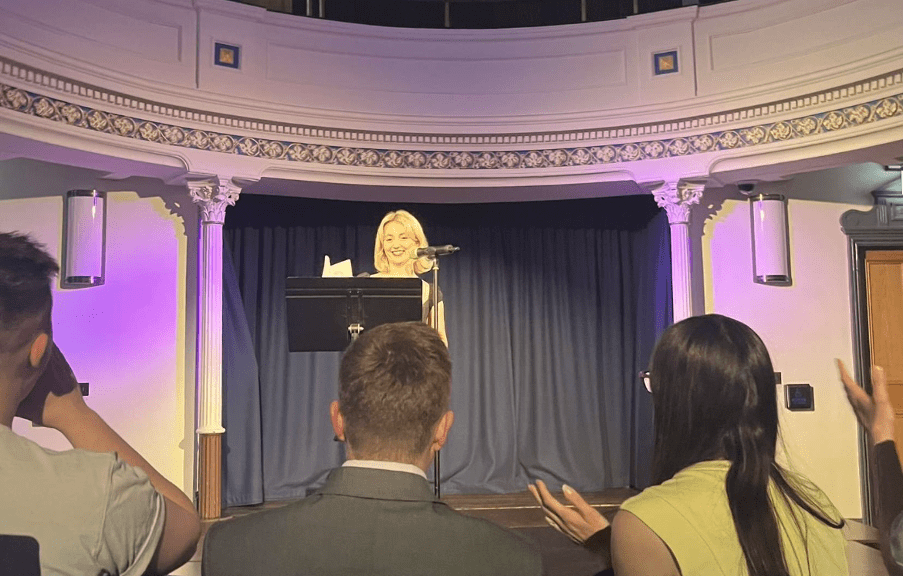
I was also fortunate to take part in the WRAP Live! and Bad Betty Press showcase of poetry, where I worked with the published writer Jessica Murrain, who helped me refine my poetry before I performed my work in front of a large audience and a livestream. It was such a pleasure to work with people who are just as passionate as I am about literature, and I enjoyed being exposed to a variety of voices. Opportunities such as these are crucial in helping you step out into the literary world, and I look forward to making use of them in the remainder of my time at NTU.
Watch WRAP Live! x Bad Betty on YouTube.
I mostly write poetry. My writing is usually philosophical with subtexts relating to mental health, feminism and female rage. I like to write what I feel I can’t necessarily otherwise say explicitly. Writing became a haven for me at a young age, and came hand in hand with reading. I had a hard time at school so I would turn to fantasy and supernatural texts as a form of escape. Even now, I use writing as an outlet.
It wasn’t until I was completing my GCSEs, though, that I considered taking writing seriously. I fell in love with Shakespeare amongst the other texts we were studying. My family always told me that if you find something you’re good at and enjoy you should pursue it, and I have never looked back. During the first lockdown in 2020, I completed my first novel which I absolutely despised and which now lives under my bed. It’s strange how writing can improve over such a small amount of time. I think wider reading is also key for improvement, but perhaps I will look back on what I’m writing now in a year or two and cringe just as much as I do now at what I wrote a few years ago. When I started writing poetry I was eager to get it out into the world, no matter how small my audience, and I performed in pubs and open mics, mostly just to share my work with my friends. I’m happy to say that eagerness is here to stay.
Though I convey my own ideas and experiences through my writing, I am also inspired by my favourite writers such as Virginia Woolf, Sylvia Plath and Margaret Atwood. To The Lighthouse and The Robber Bride are two of my favourite novels. I am currently finishing a collection of poetry which I dream to publish one day.
 NOTTINGHAM CREATIVE WRITING HUB